
The effects of gamified elements on the user experience in finTech services for young audiences
Note: As this is my masters thesis, this case study is of scientific nature.
Therefore it contains a lot theory and taxonomy - I still hope you enoy, it's worth a read!
Find the full thesis here:
https://opus4.kobv.de/opus4-haw/frontdoor/index/index/docId/4095
Gamification, the use of game-like elements in non-game contexts, has been a subject of HCI research for nearly two decades. Its applications range from language learning apps like Duolingo to fitness platforms, and it is well-established that these elements can foster intrinsic motivation and behavioral change. However, the effectiveness of gamification is deeply context-dependent, and most empirical research has concentrated on just a few domains: education, health, and crowdsourcing make up roughly 70% of all studies.
The financial technology sector, despite its explosive growth and increasing relevance to everyday life, remained largely unexplored in this regard. FinTech services come with unique challenges: users place high value on trust, privacy, and security, making the tone of these products typically serious and utilitarian. Yet FinTech is also disproportionately adopted by younger users, precisely the audience most responsive to gameful design.
This thesis set out to fill that gap by investigating two core research questions: Does a gamified FinTech service have a measurable positive effect on the gameful experience of younger users? And does it improve the overall user experience? Rather than focusing solely on behavioral outcomes (e.g., how much a user invests), the research deliberately targeted the experiential layer, the perceived gamefulness and UX quality, treating these as the mediating force between design and any downstream motivational change.
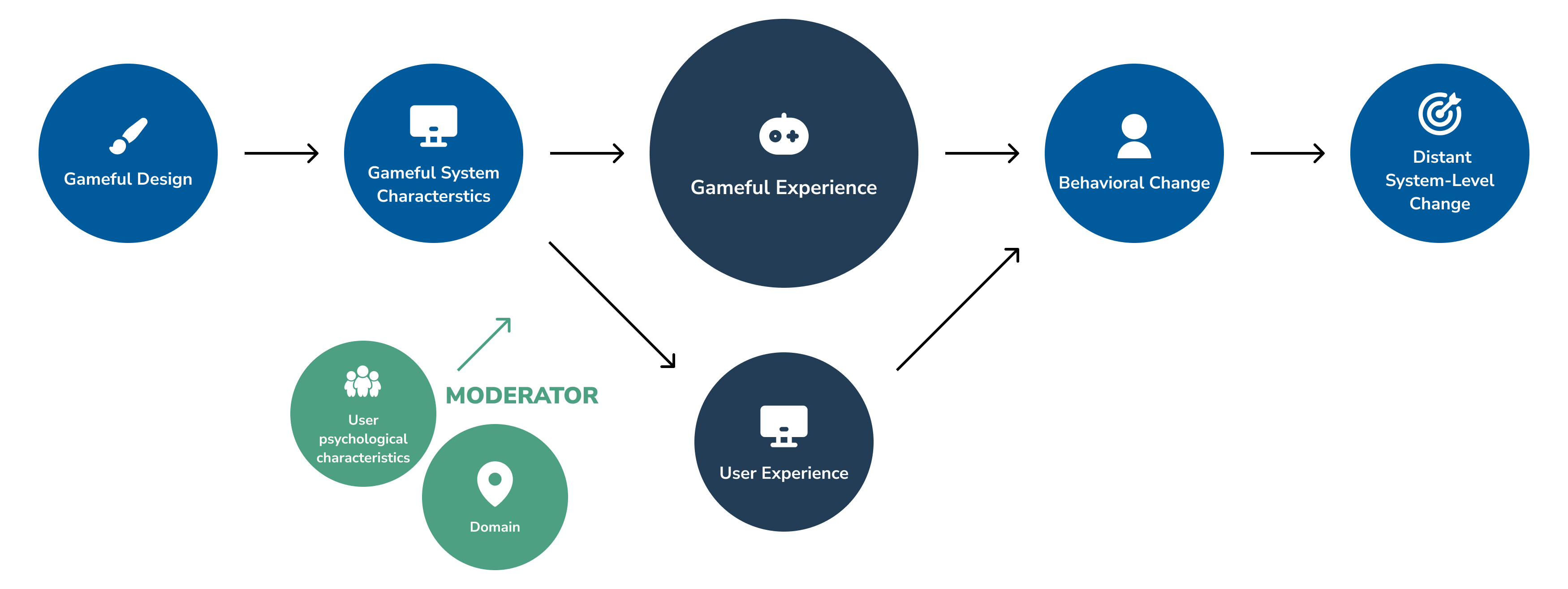
A central concept throughout the thesis is that of gameful affordances, design patterns borrowed from game design that invite users into a more playful, motivated mode of interaction. These range from pure interface affordances (leaderboards, social indicators like how many users have pressed a button) to actual interaction based affordances (like a time constraint), which oftentimes can change the complete mode of interaction happening between the user and the machine.
Drawing on existing taxonomies of gamefulness (notably the work of Deterding and Hamari), the thesis distinguishes between several dimensions of the gameful experience: challenge, accomplishment, guidance, social experience, and competition. These dimensions do not operate in isolation. They interact with and moderate one another and their relevance varies strongly by domain and user group.
Two types of gameful affordances were selected for this study based on their contrasting characteristics.
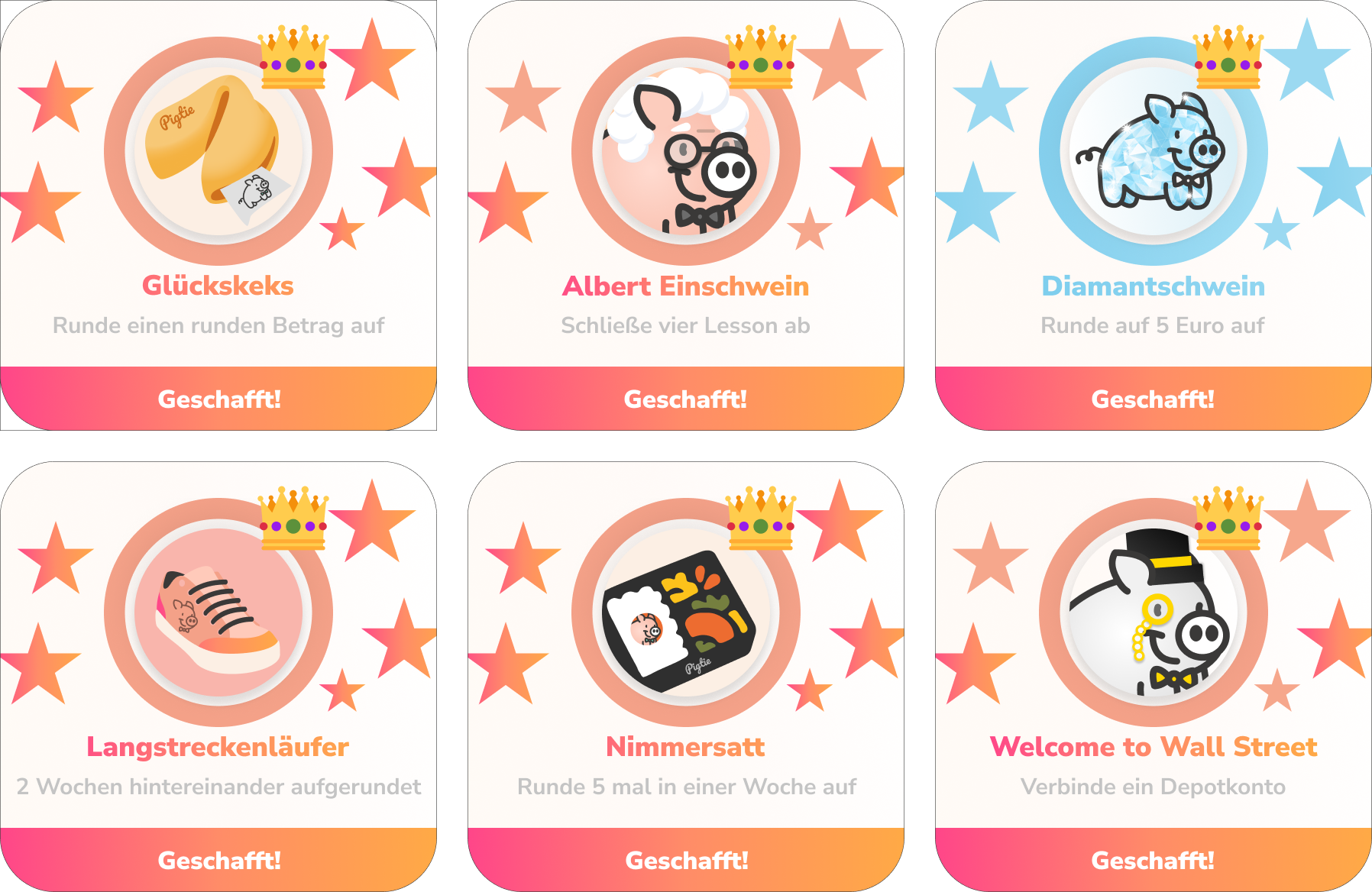
Achievement affordances (badges) provide personal, non-social feedback on progress, signaling to the user that they have reached meaningful milestones.
Leaderboard affordances introduce a social comparison element, showing users where they rank relative to others.
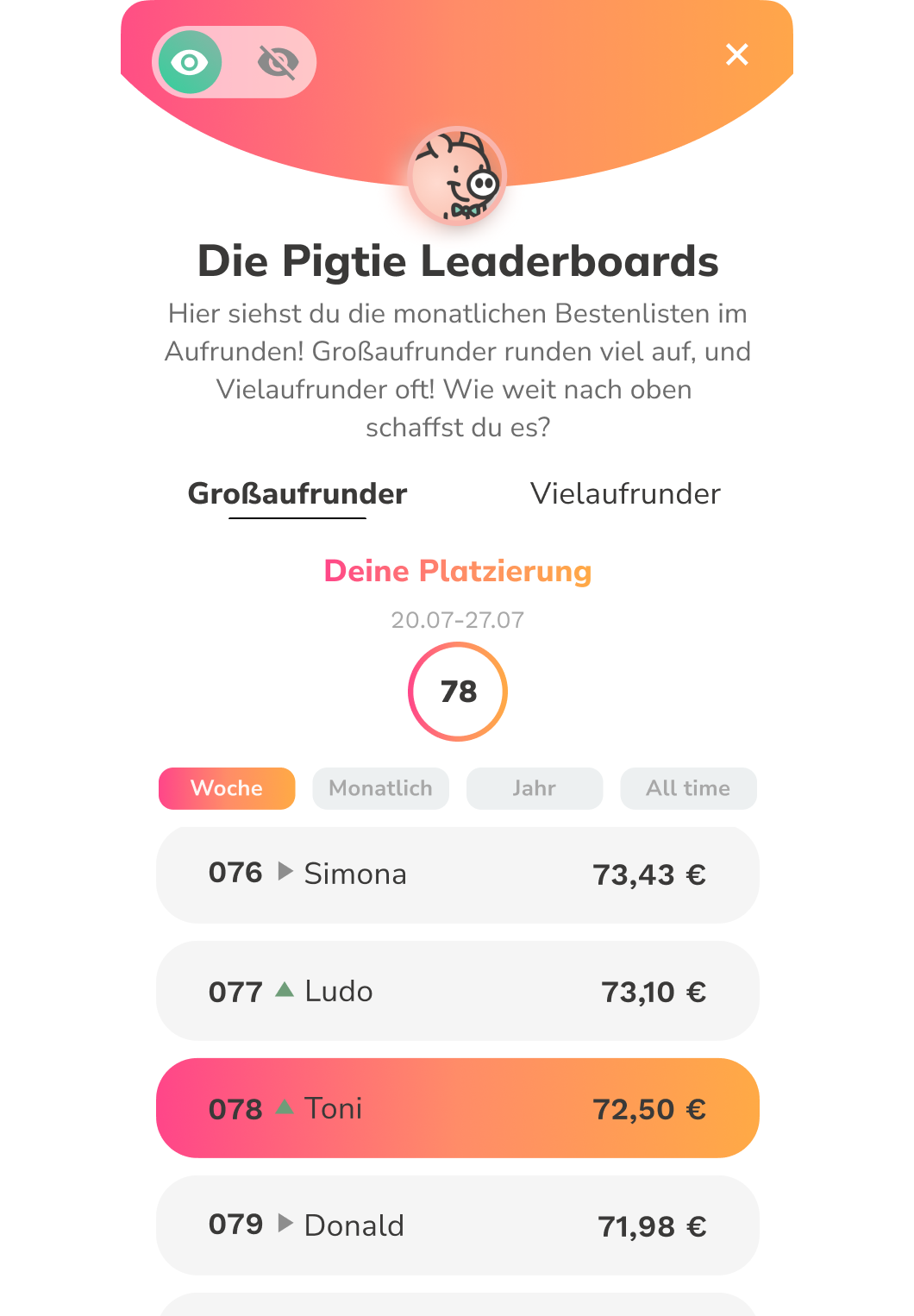
This contrast was deliberate: it allowed the study to isolate the effects of individual-oriented feedback versus socially-oriented feedback within the sensitive context of personal finance.
The study was conducted in partnership with Pigtie, a German FinTech startup founded in 2020. Pigtie's mission is to lower the barrier to long-term investing for users aged 18–32 by making the process of investing as frictionless and educational as possible.
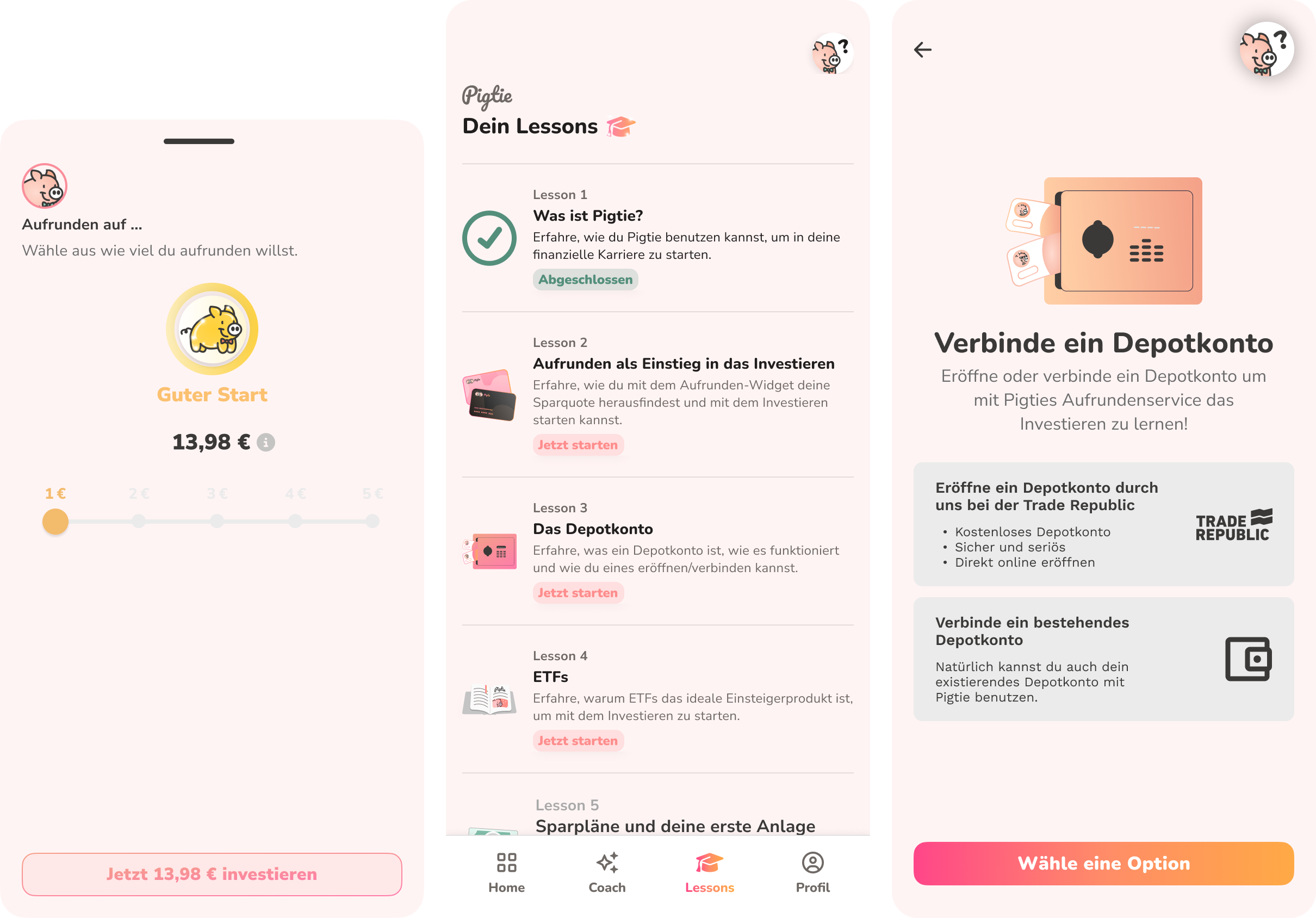
The app offers two core features. The first is a round-up system: users connect their bank account, and every daily transaction is automatically rounded up to the nearest euro, with the difference invested into ETFs. A slider lets users control how aggressively they round up (between one and five euros). The second is a lesson system: a series of four educational modules guiding users through the basics of investing, from understanding ETFs to opening a custodian account. Each lesson was paired with actionable "implement" steps to take in the real world.
Pigtie sits at the intersection of digital wealth management, digital banking, and financial education. This made it an ideal environment for gamification research: it is simultaneously utilitarian (managing real money) and educational (teaching financial concepts), and it serves a younger demographic that is digitally native but often financially inexperienced.
Participants in the study matched the target demographic: young adults between 19 and 30, all smartphone users, and all with at least one e-banking application already in use.
The research followed a User-Centered Design (UCD) process structured in two phases.
Pre-Study (n=5): Five participants tested a combined Wizard of Oz (WoZ) prototype containing both affordance designs in a within-subject setup. The goal was to uncover technical and usability issues before the main study, and to iterate on all study materials (task scripts, questionnaires, prototypes). Participants used the thinking-aloud method throughout, generating rich qualitative feedback. Multiple iterations were made to each prototype between sessions, fixing heuristic violations, refining flows, and improving legibility of questionnaire items.
Main Study (n=15): The main study used a between-subject A/B/C design with three groups of five participants each:
Each session took place in a controlled usability testing setting (both in-person and remote via Google Meet), with the thinking-aloud method running throughout. After completing a structured set of tasks in the prototype, participants filled out two validated questionnaires:
Audio recordings were transcribed and analyzed through thematic coding. Quantitative data was evaluated using t-tests and Pearson correlation.

The results were described as mixed to positive, with several notable findings:
Gameful experience: Both gamified conditions scored higher on overall perceived gamefulness than the control group, indicating that the introduction of game-like affordances into a FinTech service can produce a recognizable gameful experience, even in a single-session test. This is an encouraging signal for a domain where such effects have rarely been studied.
Hedonic quality and gamefulness correlation: A Pearson correlation test revealed a near-perfect linear relationship between perceived hedonic quality and overall gameful experience. The two appear to be deeply intertwined. But whether one drives the other or both emerge simultaneously remains an open question.
Achievements vs. Leaderboards: The achievement affordance scored highest on overall attractiveness and users found the visual badge indicators holistically fitting within the design. The leaderboard group showed more novelty in the hedonic dimension, suggesting the unusual presence of a ranking in a financial app created a fresh and stimulating effect. However, several leaderboard users expressed discomfort with the idea of competing on the basis of personal financial data, even when the data displayed (round-up amounts) was framed positively. This is a critical design insight: in sensitive domains, social comparison elements require particular care in how data is contextualized and presented, but seems to be effective nonetheless.
Guidance: The leaderboard unexpectedly improved the perceived guidance dimension. Users found that seeing their position relative to others served as a form of benchmarking and reassurance about their own progress. All leaderboard users inspected the rankings closely, while none in the achievement group explored their unearned badges. This suggests that visible social context can function as a navigational signal, not just a competitive one.
Lessons as a gameful affordance: Completing the educational lessons had a notable positive effect on both felt guidance and accomplishment even in the control condition. This points to the potential of structured lesson patterns as a form of gameful design in their own right, as they are in fact pre-built achievement systems, which is already used in various educational products across the board. They signal guidance and progress the same way badges do.
Behavioral intent: No significant behavioral change (i.e., choosing higher round-up amounts) was observed, which was expected given the short, single-session format. Motivational and behavioral changes from gamification typically unfold over time, a limitation acknowledged from the outset.
Social experience without real social setting: An unforeseen, but very welcomed result, was that a social experience can be designed even in privacy-sensitive domains. This happened not necessarily by exposing real actors, but by communicating the presence of a community (e.g., a support chat button was perceived as socially meaningful). This widens the freedom designers can use to create gameful experiences based on social interactions even in private and sensitive domain.