Pigtie is a micro-investing app designed to help younger users ease into investing by automatically rounding up small amounts from their checking account and routing them into a custodian account. This concept introduces an immediate product challenge: users must (A) connect their checking account via a PSD2 interface, and (B) either connect an existing clearing account linked to their custodian account, or open a new one through an affiliate partner within the app.
FinTech onboardings are inherently complex. They tend to be longer than typical digital onboarding flows, require information users may not have readily at hand, involve a significant amount of regulatory messaging, and deal with highly sensitive data. The goal of this project was to meaningfully improve conversion rates across the following funnel steps:
App Store to account creation
Account creation to checking account connection
Checking account connection to custodian account connection or creation via affiliate partner
Conversion rate: checking account created → affiliate lead
Conversion rate: affiliate lead → confirmed custodian sale
Custodian account to first round-up
UX Approach
Since this was the first systematic study of the onboarding experience, the team prioritized asking the right questions over jumping straight to optimization. Rather than measuring conversion rates from the outset and adjusting blindly, the approach was exploratory: identify actual user pain points by speaking directly with potential users.
Key focus areas:
Determining what questions to ask (explorative, research-first approach)
Evaluating the overall onboarding journey length: can it be shortened?
Integrating the affiliate partner journey (in this case, Trade Republic) as seamlessly as possible, including a reliable fallback for journey errors outside our control
Identifying friction points in the PSD2 interface and its web form, particularly across different banks
UX Methods:
All work was conducted within a User-Centered Design (UCD) framework, using controlled usability testing with a think-aloud protocol, followed by post-session questionnaires.
Process
Testing the Existing App
The live onboarding in the App Store was tested with 10 participants over two weeks. The group was deliberately heterogeneous within the target demographic (ages 18-32, ranging from no to limited financial literacy, none of them existing Pigtie users). Participants were selected based on expressed interest after hearing the product pitch, simulating a realistic lead scenario.
Sessions were framed as free-flow exploration across three tasks: account creation, bank connection, and custodian account opening. Each session included a task list, a test device (iOS and Android), a semi-structured interview guide used selectively, and paper prototyping materials for co-creation moments when participants had ideas to explore. Sessions concluded with the UEQ (User Experience Questionnaire). All sessions were screen-recorded, audio-recorded, and transcribed.
Findings were synthesized through thematic sorting and affinity mapping, resulting in the following key user stories:
Trust: Users were reluctant to hand over sensitive banking information to a relatively unknown brand.
Security: The existing journey offered no reassurance about how data was stored or used, compounding the trust deficit.
Visual Quality: The design was perceived as barebones and unprofessional, which likely reinforced the concerns above. UEQ scores for holistic quality fell well below benchmark.
Looking Around: Users wanted the ability to explore the app and understand its value proposition before committing their personal data.
Bugs & Technical Issues: Specific issues were documented and handed off to the development team.
Prototyping a New Journey
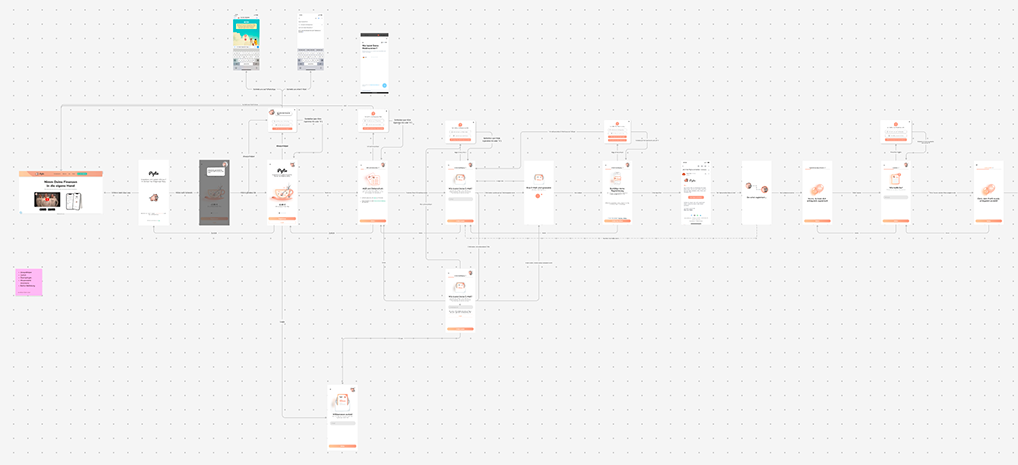
Using the insights from Step 1, a functional click prototype was built rapidly in Figma. The modular structure of the prototype allowed screens to be added, removed, and rearranged quickly based on ongoing feedback. I built a complete user flow with screenshots to accurately understand every decision a user might face and document changes made over the testing of the prototype.
The new design introduced:
Trust & Security
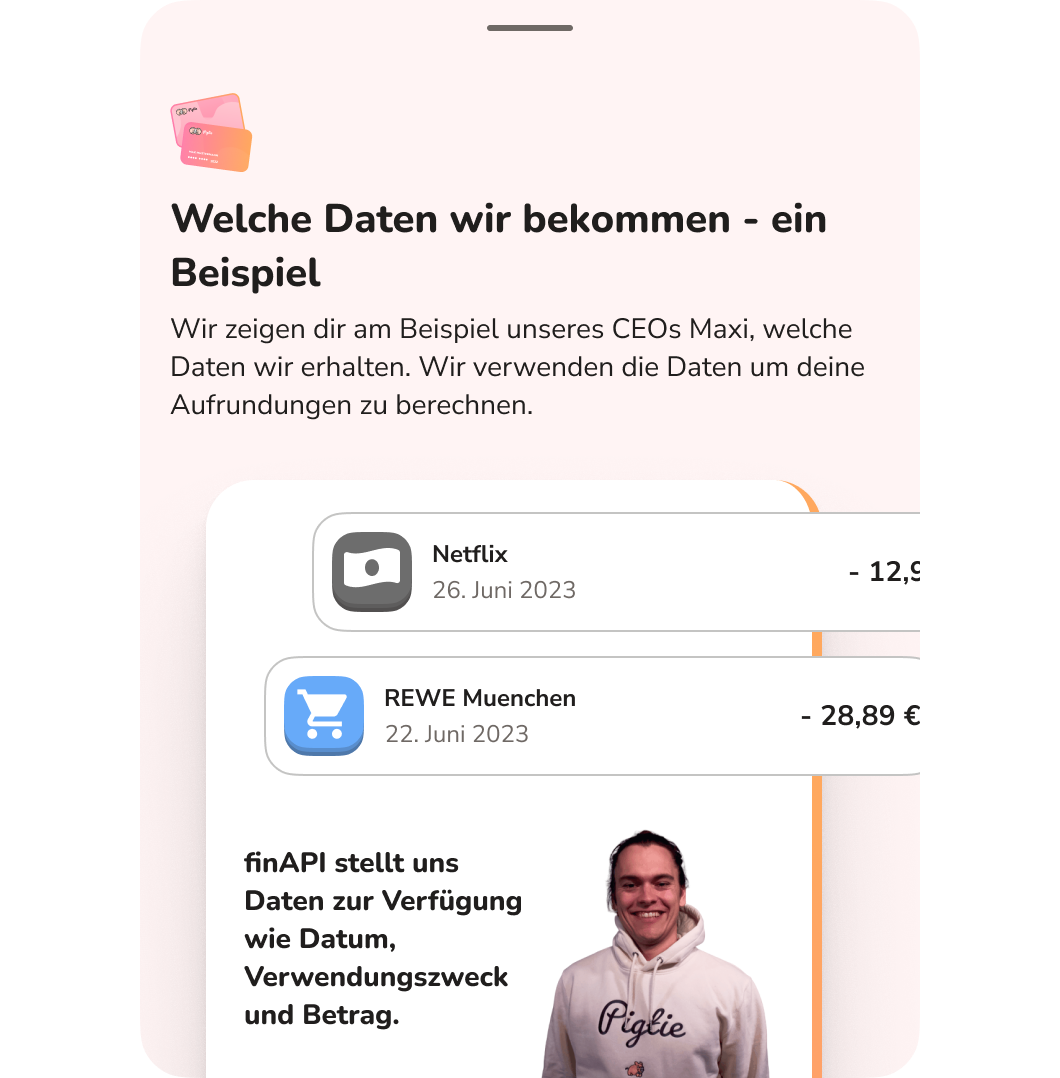
A personal statement from the CEO, featuring his real Pigtie transaction data alongside a concise explanation of what data is collected and how it is used — making the product feel human and accountable. This applies the principle of social proof through authenticity: real data from a real person is more persuasive than abstract reassurance.
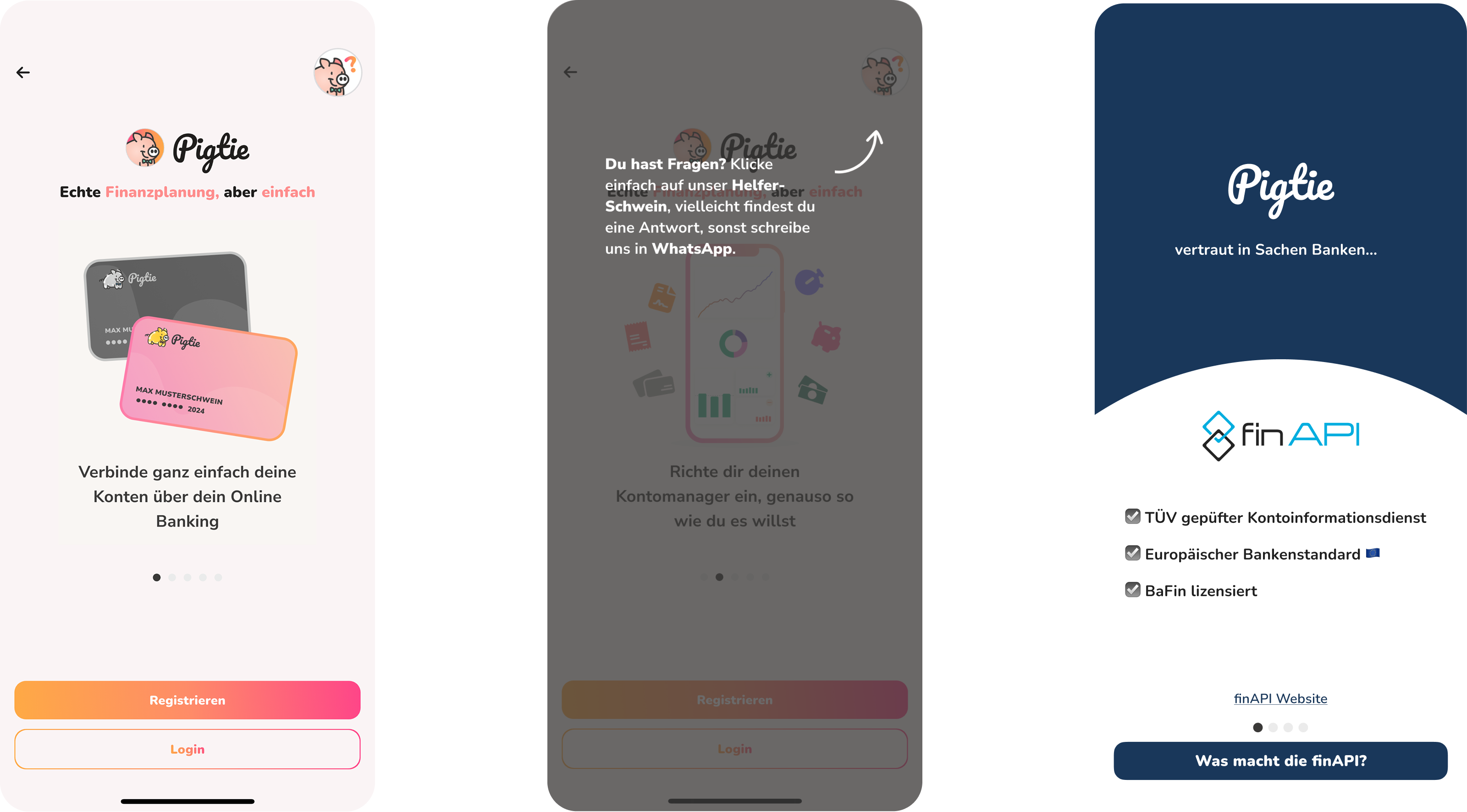
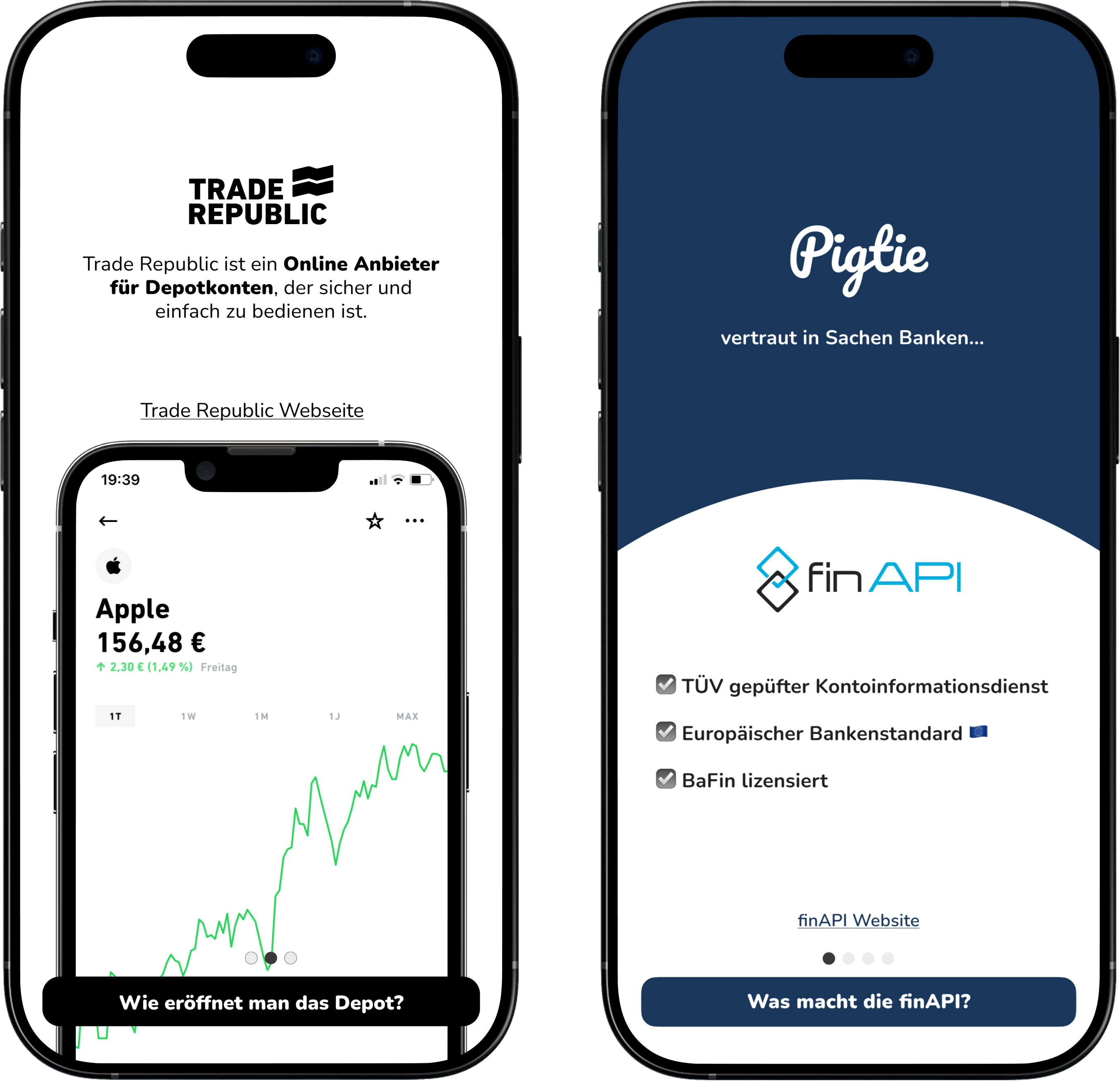
Borrowed trust via prominent partner references: PSD2 was positioned as the European regulatory standard (with links to official EU documentation), and Trade Republic was introduced earlier in the flow with dedicated screens in their own visual language.
Looking Around
The ability to exit the onboarding at any point after account creation, without losing progress.
Re-entry touchpoints built into the app to guide users back into their current step.
An extended push notification system designed to re-engage users who dropped off, with context-aware messages linking directly to where they left off
This is a classic value-before-commitment pattern: users need to understand what they're signing up for before they're willing to give anything in return.
Visual Quality
A refined screen UI with a consistent design language, a progress bar (a common follow-through driver) to set time expectations, and custom illustrations and animations throughout the flow
Validating the Prototype
The revised prototype was tested with 7 participants over two weeks, drawn from the same target demographic. This round was more focused and evaluative: rather than generating new user stories, the goal was to validate the design decisions made in Step 2 and identify any remaining friction.
Sessions followed the same structure as Round 1, including the UEQ for direct score comparison.
Outcomes:
Only minor UI adjustments were needed, no structural changes to the journey.
UEQ scores improved significantly, especially on hedonic quality. Holistic quality also improved, though not to the degree the team had hoped.
No new, addressable pain points surfaced. Some issues fell outside the team's control, for example, users who didn't have their banking login credentials available when starting the onboarding on the go.
Implementation & Results
Following the final iteration, a dev handoff was completed with clearly defined goals and a finished high-fidelity design. Implementation work in Flutter included UI development and the rollout of a new design system and component library built on a variable token structure.
The results exceeded expectations:
Custodian lead generation increased considerable into the two digit range,
All other funnel conversion rates improved, with the most dramatic gains in checking account connection, driven largely by the new trust screens using real team transaction data.
The "look around" feature saw strong adoption. The notification re-engagement system also successfully converted a meaningful share of users who had previously dropped off.
Remaining challenges:
PSD2 interface errors, originating from third-party bank integrations, continued to generate customer care inquiries in the weeks following launch. These lay outside the team's scope.
The Trade Republic journey was displayed in a WebView within the app. While this allowed some funnel-back mechanics, it was technically fragile and contributed to intermittent errors.
The holistic quality of the design, while improved, did not fully reach the "professional" perception the team was aiming for.
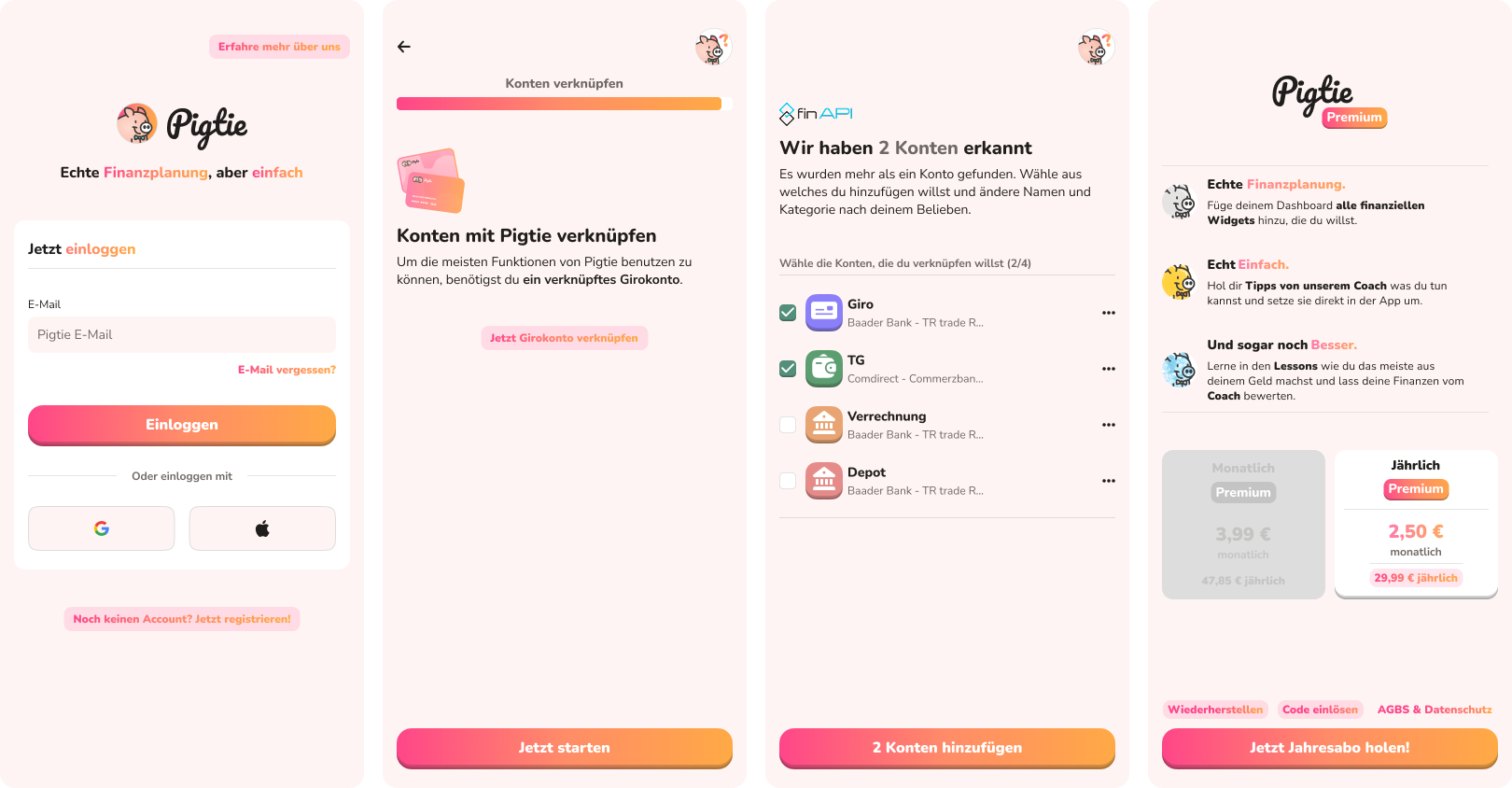
After this inital design, I had the opportunity to continue to improve the onboarding experience and make sure it works over the years, even when the conext of the app changes. This happened, when Pigties financial scope got broader - now Pigtie needed all accounts from the user to have an accurate picture of their financial situation. Below are some sample screens, which are also currently live in the app.
Reflection
The project achieved its core goals: key metrics moved significantly, the quality of collected data was high, and the product improved in a meaningful and measurable way. The experience reinforced the value of face-to-face usability testing, particularly for a product in a trust-sensitive category where indirect signals can easily mislead.
What I would do differently:
Prototype scope: The prototype became more complex than necessary, consuming time that could have been spent elsewhere. A leaner prototype would have been sufficient to validate the core design hypotheses.
Prioritization of findings: Pain points tied to third-party systems or regulatory constraints received more investigative attention than they warranted. Better upfront alignment with the development team, and a more ruthless prioritization of what was actually addressable, would have made the process more efficient.